This ‘n’ That – An anthology of short stories and drawings’
I’m very excited to announce that my collection of short stories, poems and whimsical drawings is now available on Amazon, in a paperback edition. Some of the stories will make you laugh, some will make you cry. I hope all of them will make you feel … feel something lovely. I certainly enjoyed throwing myself into writing them. I’d love to hear what you think, so please–don’t forget to leave a review on Amazon after you’ve read the book.
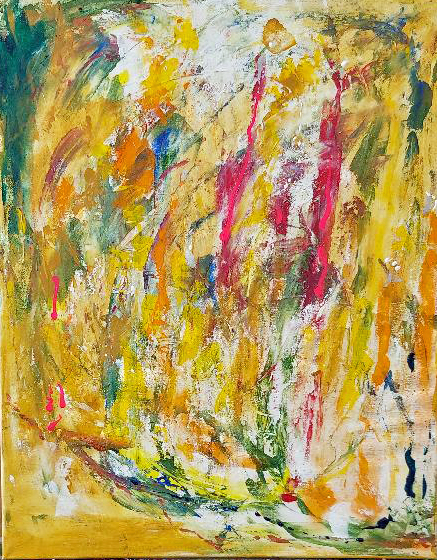
Given the events of the past two weeks, this pretty much expresses my feelings. Even though it represents total chaos, I still think my painting has balance of design and color, so it’s not completely chaotic, not yet anyway. But as for the future, ….?
I was tempted to just smear on paint at random, but being an artist, I couldn’t leave it at that, so although this small painting has lots of texture and random marks, I still took the time to judge the need for color complements, focal points, and other compositional elements.
Having gotten the initial impulse out of my system, I’ve just begun another rendition, so I guess the idea of chaos has served me well, in the short term at least, because I broke through my ‘painter’s block’ and am working again, after a hiatus. Feels good. Hope you like the results.
We just recently celebrated the holiday of Chanukah, and one of the songs associated with this holiday is Ocho Kandelikas (Eight Candles), a reference to the number of candles lit during the holiday, one for each of 8 nights. This song is written in Ladino, a Spanish-Hebrew language originally spoken by the Jews of Iberia.
While walking around the studio, humming this song, my paint brushes decided to transform the canvas I was working on into an homage to ocho kandelikas, so here it is. I love creating abstract designs, letting the colors flow, adding highlights where they need to be. Plenty of texture, too, though that doesn’t come through well in the photo. But you can find 8 candles there, if you look carefully.
While walking through the woods near home the other day, I got to thinking about how freezing cold it was, and about the trees. Have you ever wondered about trees? What they’re thinking? What they’re feeling? Here’s my take on it. I’m including one of my pastel paintings to help illustrate it.
Winter
Empty, gray sky. And cold. Very cold. I know the sun is out there someplace, but it gives no warmth. I’m standing alone, unprotected, yet … the sap shivers in my veins and tells me I’m still alive. Comforting. I miss the birds, though.
Still, my friends are standing nearby, tall and strong, if also bare and defenseless like myself. Many of them are not as strong as they used to be. The winters have taken their toll. None of us has much to say, but we can feel each other and know we are still together.
Most of us, anyway. A few have fallen in the past year. I heard the dull thuds as they toppled, felt the earth shake. For a while, they lay randomly, some leaning drunkenly against old friends, some stretched out along the ground, among the fallen leaves and broken branches. The deer nibbled at their bark, the squirrels scrambled over their twisted limbs, not yet crumbled into the earth. Sad, certainly, but to be expected. It was a tough year—aren’t they all?—so some of them were bound to have succumbed to the storms. And some simply got too old and tired to stand. They’re not entirely lost to the world, though. No. Their spirits, their memories are with me still.
As is the empty nest that clings to my top branches. The little ones are gone, of course. Off to live their own lives, as is proper. They never glance back once they leave me. I wonder if they even remember me at all. Well, that’s life, I guess. In the spring, the hawks will return, to freshen up the old nest for a new family. And so it goes.
The forest is quiet and still, but not abandoned. There is movement now and then, defying the cold. I wonder what it must be like, to propel oneself along on one’s own branches, as those moving along the path are doing. Free and confident. Maybe scary, too. After all, there’s a lot to be said for the stability of occupying one’s own space, surrounded by others who are doing the same, for as long as we can. The beings who matter to us the most stay put. They don’t leave us, not until they disappear, slowly, to become united with the earth from which they emerged so long ago. Safer that way.
Winter is not my favorite season. The cold, the early dark–make me want to pull the covers over my head and stay in bed until Spring. But that way lies madness–right? So get up and paint, I tell myself. Remember the warmth and color of the sun. It’s still out there, even though it’s doing its best to hide from us right now. So I reminded myself of the Caribbean–the lush islands, the beach, the sea. And I got out my paints, squeezed out a pile of yellow, grabbed a brush, and started smearing paint on a couple of canvases. And guess what? Today, after a couple of weeks of intense cold, the sun did come out and the earth warmed up a bit. So I guess my ploy worked, for today, at least.
First, I did a little vignette.
Sand and Sea, acrylic, 12 x 12
Next, encouraged, I branched out into something a bit more substantial, focusing on the light, the sun filling the sky. So that’s how this landscape came by its name.
The Red Star Line Museum resides in an old red brick building at the docks in Antwerp. It was in this building that millions of emigrants spent their last days in Europe before setting sail on one of the Red Star Line ships for America. My grandmother, father and uncle were three of those people, about whose journey I wrote in Riva’s Journey: a Memoir (Amazon.com, paperback and Kindle editions). Last Tuesday, I had the opportunity to visit the museum for myself.
It was incredible for me to stand inside the same building where my family stood over 100 years ago, ready to leave behind everything they’d ever known to try to build a future in a new land. The museum itself has exhibits detailing the stories of many of the emigrants who passed through there, and is fascinating to visit. Directly across from it are the docks that are still busy and active today, where my husband and I walked past cranes poised to load new ships on new journeys.
The museum is set up to allow visitors to search their databases for ship’s manifests, etc., but there are no records available from 1920, as many were destroyed during World War II. I tried anyway, but no luck. Oh, well–fortunately Ellis Island has many of the same records in their data bases, which is how I know my family sailed on the SS Lapland. So amazing to have been able to visit this site!
From earliest times, people have used pictures to tell a story. Following in this narrative tradition, I have created, over a period of years, a body of work that tells the stories of some of my earliest memories. Many of these paintings are hanging in our family room at this moment. Looking at them recently, I realized that I need to take the exhibit a step further.
Pictures are great, but to really tell a complete story, you need words. At least, I do. So I decided to add a ‘narrative’ to my ‘history paintings,’ so that subsequent generations will understand what I had in mind when I painted them.
I grew up in Chicago in the 1950’s and 60’s. My family was close, both in physical proximity and emotionally. My aunt and uncle, and my grandparents were always in each other’s apartments, celebrating holidays and family events, as well as taking many outings together within the city. They’re all gone now, but my memories of them are still vivid and alive.
Times change, and the lifestyle we enjoyed then is no longer possible, with families spread out all over the world. We don’t live in each other’s pockets anymore. So stories will have to take the place of experiences, and maybe my paintings can make my stories more vivid and real.
For example, Passover on 19th Street, shows a family at a Passover Seder. My father, grandfather, and uncle are reading from the Hagaddah, while my Grandma and aunt are working in the kitchen. My mom is next to my dad, putting a bowl of chicken soup with matzo balls on the table. The table is set with the traditional seder plate, wine and matzo, and the children are all at the table with the family. On the left side of the painting, a goat, (a kid-from the traditional song in the Hagaddah Chad Gadya – about one kid that father sold for two zuzim) peeks over the front door, and on the right side, there are the apartment houses that we lived in on Chicago’s West Side. There are a few extra guests at the Seder, which would have been normal. And the dining room isn’t what my grandma’s dining room looked like. But none of that is the point. What I hope viewers get from this painting is the sense of closeness and family celebrating a beloved holiday in a traditional way. I loved painting it.
I just spent 2 very happy Saturdays at the Scottsdale Artists’ School Portrait Open Studio. It’s been 7 years since I was a regular there, every Saturday morning, and it was fantastic to be back again. And…I learned a new technique. New to me, anyway.
I hadn’t brought any paints with me, only drawing materials, but I noticed that most of the others were doing “value paintings” using an oil palette of white, burnt sienna, and viridian. I’ve done plenty of value paintings, but never with viridian, so I couldn’t wait to get back to my own studio, break out the oil paints, and try it for myself. Today was the day!
I haven’t used oils in a while, but using them again today reminded me of why I love them and used them for so many years. They are so easy to play with, and they stay workable for hours, so there’s no rush. I can relax, take my time and enjoy the process. For my first effort at the new technique, I decided to copy one of the drawings I’d done at the Open Studio. I’m pretty happy with it, though still not sure if I like the viridian or not. I’ll work on it some more tomorrow, but here’s the ‘first draft.’
Monica, 12 x 9, oil and Monica, charcoal on paper, 14 x 11
There’s a reason traditional publishers earn the big bucks! I’ve just spent an exhausting several days attempting to update my website to include the latest novel in my Bella Sarver Mystery series: The Butterfly Carpet Murders. Having only the very foggiest knowledge of how to do all this, what would probably have taken a pro an hour or two took me forever, with lots and lots of trial and error. But finally, I think I’ve managed it. So check it out and see what you think. I’d love to hear comments and suggestions.
Hope you enjoy reading the book. I had a great time writing it!
The Butterfly Carpet Murders, the latest addition to my Bella Sarver Mystery series, is now available on Amazon.com.
It’s been a long two years and the pandemic isn’t over yet, but it’s finally under control, thanks to vaccines, masks, and treatment options. Bella Sarver and her husband, Art Halperin, are thrilled to be able to travel once more. They’ve been so looking forward to visiting the UK, particularly, the Scottish Highlands, home to so much beauty and fascinating history. True to expectations, the Highlands are indeed beautiful, but they’re also filled with ghosts from the past, ghosts that insist on intruding into the present. When one of their fellow tourists meets with an accident, Bella wonders – was it an accident? Or something more sinister? Could it really be the curse of the butterfly carpet?
Though Art is leery of his wife getting involved with the case, Bella can’t help herself. She just has to figure out ‘who dunnit?’ Doesn’t she?








 Lipkin Gallery