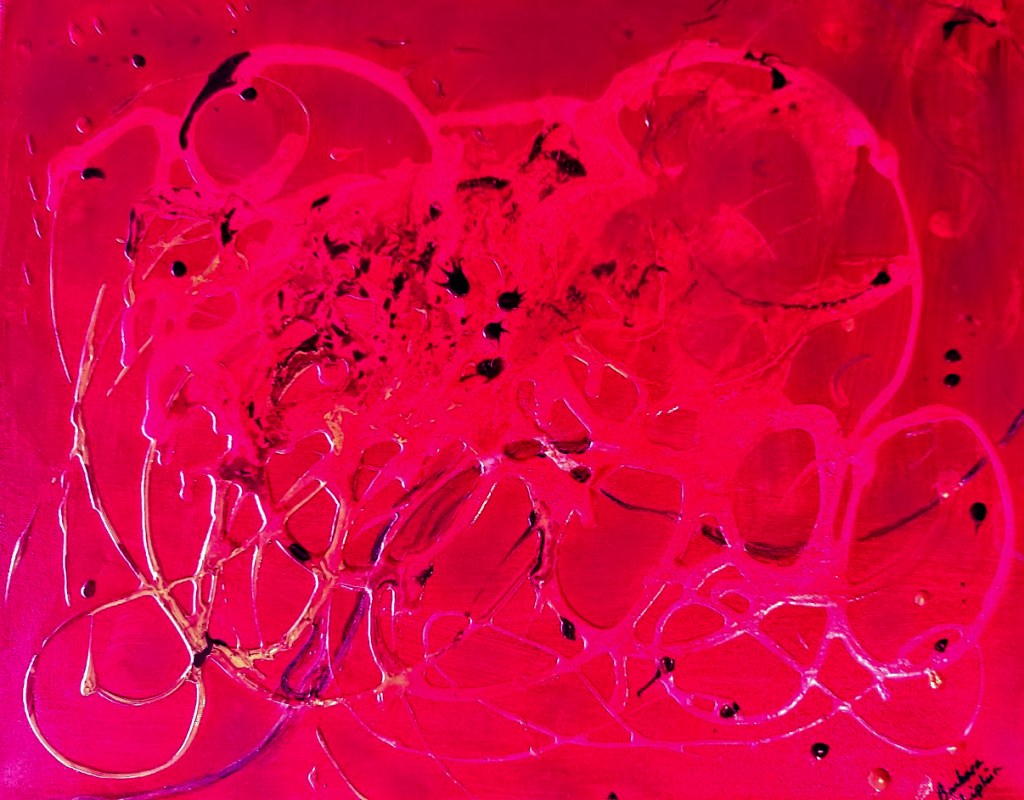
In my previous post, I wrote about using a 12 x 12 format to express a single idea, but sometimes, I need a bigger canvas to capture the moment. A River Runs Through It reminds me of the colorful river towns perched on the hilltops in Spain. The water rushing down the mountains, the clean, fresh air! Aah–how delightful.
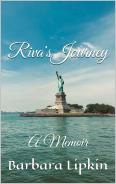
While I was researching and writing Riva’s Journey: a Memoir, (now available on Amazon), I uncovered tons of facts about conditions in Eastern Europe during the late 19th-early 20th centuries that I wasn’t able to incorporate into my grandmother’s story. I hated to let go of all that information, so I decided to use it to create a presentation for my community’s History Club. I wanted to talk about how fully half the world’s Jews came to live in the Kingdom of Poland, under what sort of conditions they lived their lives, and the profound socio-cultural-political changes that happened in the century and a half after the first Polish partition in 1772. What led so many Eastern Europeans, Jews but also millions of Poles, Russians, and others to pick up and cross the Atlantic in search of better lives? To round out the story, I decided to expand the presentation to discuss the Atlantic crossing and the reception the immigrants received once they arrived in New York.
I’ve given this presentation twice now—once to a group at my synagogue and then to the History Club. Both times, I’ve realized that I probably bit off more than I could chew. There’s so much material that covering it in only one hour doesn’t really do justice to the subject. Still, I hated to leave anything out, and people did seem to enjoy hearing about all of it.
The whole experience reminds me that originally, decades ago, I prepared to teach history, a subject to which I was drawn because I always wanted to know “what happened? Why?” And each time I revisit an era, I not only find answers to my questions, but also discover new insights and deepen my understanding of the events I’m studying. Maybe I’m returning to my academic roots after all this time. Whatever—I’m enjoying the detour.
Everyone in the United States today is an immigrant or descended from immigrants, with the exception of Native Americans whose ancestors were here before Columbus. Between 1880 and 1920, people from Eastern and Southern Europe poured into the United States by the millions. They were Russians and Poles, Czechs and Romanians, Italians, Greeks and Ukrainians. All of our ancestors came from someplace else. Riva’s Journey explores the reasons why one large group of people, Jews who’d been born in the Russian Pale of Settlement, decided to leave their homes and immigrate to the United States, and how they adjusted to becoming Americans. Riva’s Journey tells the story of one woman, and one family, who made the trip.
There’s a curse, erroneously attributed to the Chinese, that goes, “May you live in interesting times. Riva’s Journey is the fictionalized memoir of a woman whose life spanned the start of the Industrial Revolution in Tsarist Russia to the post-war prosperity of the United States—my grandmother. She lived in very interesting times.
It was a time of vast social and political changes in the area defined as the Pale of Settlement, established by Catherine the Great of Russia about 1791, after Russia took over large parts of what had been Poland, Ukraine, Lithuania, and more, and incorporated those areas into the Russian Empire. Jews were forbidden to establish new settlements outside the Pale, nor could they live in most major cities such as Moscow. The May Laws of 1881 further severely limited Jewish rights to own land, to access education, and to engage in business. The majority of Jews relocated to various large towns and cities, pursued livelihoods in trades and small businesses, or found jobs in the newly established factories that sprouted up as industrialization of Russia progressed.
Now available for pre-order on Amazon. Get the book delivered directly to your E-reader on September 29th.
Everyone in the United States today is an immigrant or descended from immigrants, with the exception of Native Americans whose ancestors were here before Columbus. Between 1880 and 1920, people from Eastern and Southern Europe poured into the United States by the millions. They were Russians and Poles, Czechs and Romanians, Italians, Greeks and Ukrainians. All of our ancestors came from someplace else. Riva’sJourneyexplores the reasons why one large group of people, Jews who’d been born in the Russian Pale of Settlement, decided to leave their homes and immigrate to the United States, and how they adjusted to becoming Americans. Riva’s Journey tells the story of one woman, and one family, who made the trip.
There’s a curse, erroneously attributed to the Chinese, that goes, “May you live in interesting times. Riva’s Journey is the fictionalized memoir of a woman whose life spanned the start of the Industrial Revolution in Tsarist Russia to the post-war prosperity of the United States—my grandmother. She lived in very interesting times.
It was a time of vast social and political changes in the area defined as the Pale of Settlement, established by Catherine the Great of Russia about 1791, after Russia took over large parts of what had been Poland, Ukraine, Lithuania, and more, and incorporated those areas into the Russian Empire. Jews were forbidden to establish new settlements outside the Pale, nor could they live in most major cities such as Moscow. The May Laws of 1881 further severely limited Jewish rights to own land, to access education, and to engage in business. The majority of Jews relocated to various large towns and cities, pursued livelihoods in trades and small businesses, or found jobs in the newly established factories that sprouted up as industrialization of Russia progressed.
Special Offer, 1 week only – September 1 to September 8
Take advantage of the Kindle Countdown deal to purchase A Wonderful Good Morning at a discount price, only on Amazon. A Wonderful Good Morning is a mystery with a bit of science fiction thrown in. If you enjoyed Groundhog Day, you’ll love A Wonderful Good Morning.
Sometimes every day seems just like the one before. Sometimes, it really is the day before.
Strange things have been happening to Tim for a while now. Lately, his friends have learned to treat him very gently until he comes out of one of his spells. His girlfriend, Natalie, decides a Rhine River cruise will be just what the two of them need to get things back to normal, but at the last minute, Tim is left to sail on his own. That’s when things get really weird. While he stares, yet again, at the very same clumps of algae in the very same stretch of the Rhine he’s been looking at for days, something finally clicks. Now the only problem is – how to fix it.
Meanwhile, Natalie and her artist friends back in Chicago wonder why Tim hasn’t returned from his vacation and why he doesn’t answer his phone. It’s not like him to just disappear; he’s normally super responsible. They have no choice but to set off for Europe to find out what’s going on.
A little while ago, I wrote about the importance of establishing genre when marketing your novels. A similar factor comes into play when peddling paintings. One of the first things an artist learns when creating a body of work is that it needs to be consistent, i.e., the viewers/prospective purchasers need to know what to expect when they hear your name. That’s fine, except if you’ve ever been to a retrospective of the work of a well-known artist, you’ll notice that their work has gone through many stages both before and after emerging into the characteristic style for which they’re known. It almost goes without saying that an artist is, by the very nature of the craft, an experimenter. So how to reconcile the demands of the artist with the demands of the public?
I’ve always loved abstract design, so although most of my paintings are representational to some extent, they’re also colorful, whimsical, and sometimes purely abstract. There’s nothing more fun than grabbing a nice, fat brush and smearing paint on a canvas, watching the colors and patterns develop, until you have either a big mess or a delightful new piece of art. (Naturally, you never show anybody the big messes. You just paint over them, and the mess becomes part of the ‘history’ of the new painting.) But at other times, I enjoy carefully designing a composition and slowly making it come to life with deliberate, well-placed strokes. At this stage of my life, I’ve pretty much stopped worrying about whether or not a new piece ‘fits’ consistently in my body of work. I just go with whatever I want to try next.
My two most recent pieces couldn’t be more different. But I enjoyed both of them.
Dreaming, Acrylic, 24 x 20A River Runs Through It, Acrylic, 20 x 24
I’m excited to announce that my new Science Fiction novel is now available on Amazon in both Kindle and print versions. Thanks to everyone who pre-ordered the Kindle version, which you should have received yesterday. I hope you enjoy it, and will take a minute to write a review on Amazon and/or Goodreads.
I have to say, I never saw myself as a Science Fiction writer before. But like creating mysteries, writing sci-fi is a matter of asking yourself “what if?” In A Wonderful Good Morning, the what if? is–what if our world is changing even more than we realize? What happens to an ordinary person then?
Sometimes every day seems just like the one before. Sometimes, it really is the day before.
Strange things have been happening to Tim for a while now. Lately, his friends have learned to treat him very gently until he comes out of one of his spells. His girlfriend, Natalie, decides a Rhine River cruise will be just what the two of them need to get things back to normal, but at the last minute, Tim is left to sail on his own. That’s when things get really weird. While he stares, yet again, at the very same clumps of algae in the very same stretch of the Rhine he’s been looking at for days, something finally clicks. Now the only problem is – how to fix it.
Meanwhile, Natalie and her artist friends back in Chicago wonder why Tim hasn’t returned from his vacation and why he doesn’t answer his phone. It’s not like him to just disappear; he’s normally super responsible. They have no choice but to set off for Europe to find out what’s going on.
Hope Rising, Inspiration, and Welcome, Mixed Media, 12 x 12
My paintings and designs have been taking a whimsical turn for a while now, using a variety of different paints and applicators. Here I’ve used the marvelous Golden Fluid Acrylics, plus a variety of paint markers, to see what would happen if I just let ‘the spirit move me.’ My three most recent results say go with the flow and enjoy! Framed very simply, & ready to brighten up a corner of your room.
I finished revising Riva’s Journey, the fictionalized memoir of my grandmother’s life from the time she came of age in the Jewish Pale of Settlement to the time she came to feel like a real American, after the second World War. So now, I’m on Round #2 of searching for an agent to help me get my manuscript published.
As I mentioned with regard to my Science Fiction novel, A Wonderful Good Morning, searching for an agent is probably one of the most tedious endeavors I’ve ever attempted, but therein lies the route to traditional publishing. I’ve given myself a deadline of June 30th. If I don’t have a positive response by then, I will self-publish with the help of Kindle Direct Publishing, as I have done with my Bella Sarver Mystery Series. But it would certainly be nice to have the backing of a traditional publisher, with its many resources for marketing and promotion.
So one way or the other, watch for my two newest novels, out later this year.
I bought this Turkish coffee pot in Istanbul years ago, in a little bazaar filled with rugs and leather jackets and the aroma of exotic spices. Today seemed like a good day to put it into a painting, using autumn tones but hopeful little flowers to help us get through the winter that’s almost upon us. When Spring comes again, we can hope that most of us will have been vaccinated, and we can begin to emerge into the light again.