This ‘n’ That – An anthology of short stories and drawings’
I’m very excited to announce that my collection of short stories, poems and whimsical drawings is now available on Amazon, in a paperback edition. Some of the stories will make you laugh, some will make you cry. I hope all of them will make you feel … feel something lovely. I certainly enjoyed throwing myself into writing them. I’d love to hear what you think, so please–don’t forget to leave a review on Amazon after you’ve read the book.
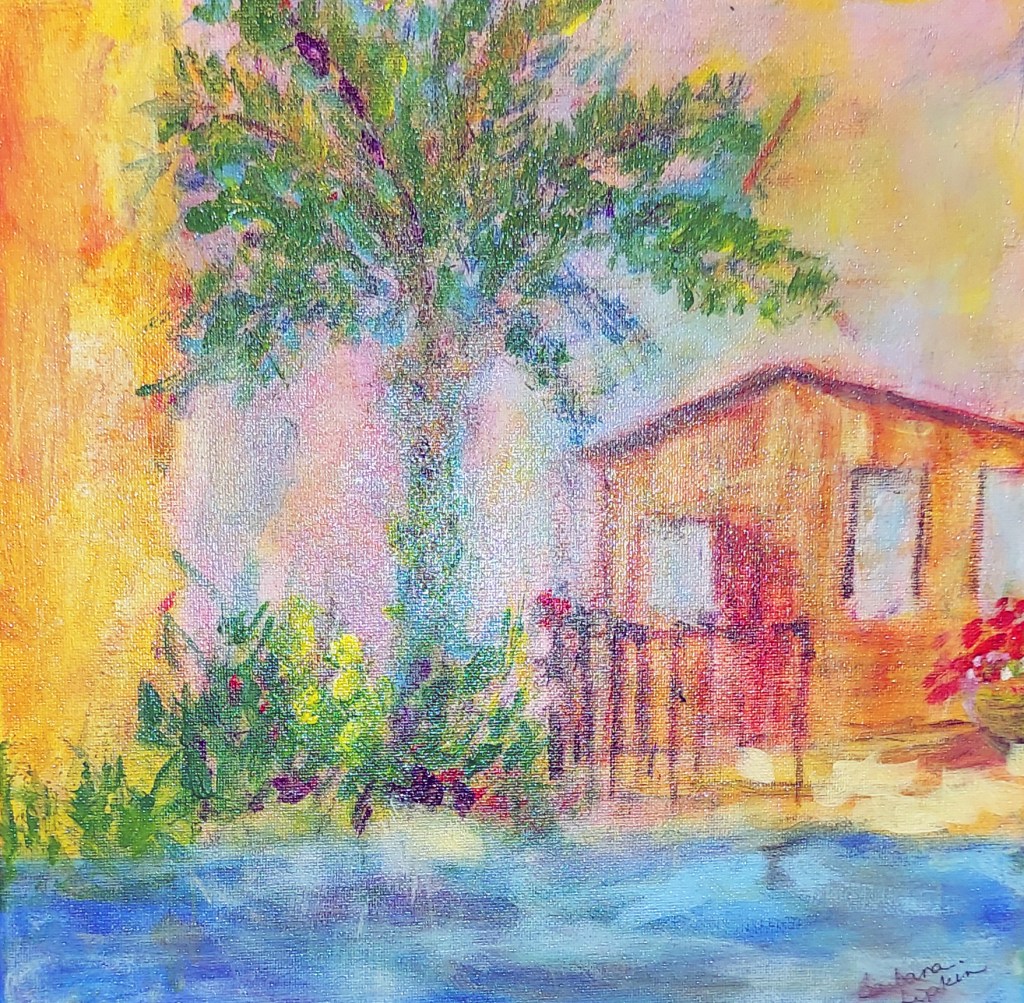
Winter is not my favorite season. The cold, the early dark–make me want to pull the covers over my head and stay in bed until Spring. But that way lies madness–right? So get up and paint, I tell myself. Remember the warmth and color of the sun. It’s still out there, even though it’s doing its best to hide from us right now. So I reminded myself of the Caribbean–the lush islands, the beach, the sea. And I got out my paints, squeezed out a pile of yellow, grabbed a brush, and started smearing paint on a couple of canvases. And guess what? Today, after a couple of weeks of intense cold, the sun did come out and the earth warmed up a bit. So I guess my ploy worked, for today, at least.
First, I did a little vignette.
Sand and Sea, acrylic, 12 x 12
Next, encouraged, I branched out into something a bit more substantial, focusing on the light, the sun filling the sky. So that’s how this landscape came by its name.
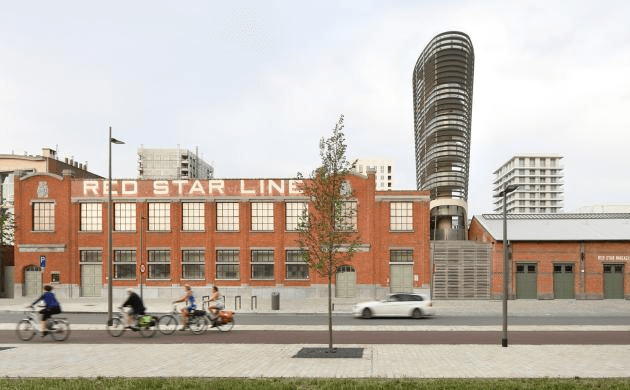
The Red Star Line Museum resides in an old red brick building at the docks in Antwerp. It was in this building that millions of emigrants spent their last days in Europe before setting sail on one of the Red Star Line ships for America. My grandmother, father and uncle were three of those people, about whose journey I wrote in Riva’s Journey: a Memoir (Amazon.com, paperback and Kindle editions). Last Tuesday, I had the opportunity to visit the museum for myself.
It was incredible for me to stand inside the same building where my family stood over 100 years ago, ready to leave behind everything they’d ever known to try to build a future in a new land. The museum itself has exhibits detailing the stories of many of the emigrants who passed through there, and is fascinating to visit. Directly across from it are the docks that are still busy and active today, where my husband and I walked past cranes poised to load new ships on new journeys.
The museum is set up to allow visitors to search their databases for ship’s manifests, etc., but there are no records available from 1920, as many were destroyed during World War II. I tried anyway, but no luck. Oh, well–fortunately Ellis Island has many of the same records in their data bases, which is how I know my family sailed on the SS Lapland. So amazing to have been able to visit this site!
From earliest times, people have used pictures to tell a story. Following in this narrative tradition, I have created, over a period of years, a body of work that tells the stories of some of my earliest memories. Many of these paintings are hanging in our family room at this moment. Looking at them recently, I realized that I need to take the exhibit a step further.
Pictures are great, but to really tell a complete story, you need words. At least, I do. So I decided to add a ‘narrative’ to my ‘history paintings,’ so that subsequent generations will understand what I had in mind when I painted them.
I grew up in Chicago in the 1950’s and 60’s. My family was close, both in physical proximity and emotionally. My aunt and uncle, and my grandparents were always in each other’s apartments, celebrating holidays and family events, as well as taking many outings together within the city. They’re all gone now, but my memories of them are still vivid and alive.
Times change, and the lifestyle we enjoyed then is no longer possible, with families spread out all over the world. We don’t live in each other’s pockets anymore. So stories will have to take the place of experiences, and maybe my paintings can make my stories more vivid and real.
For example, Passover on 19th Street, shows a family at a Passover Seder. My father, grandfather, and uncle are reading from the Hagaddah, while my Grandma and aunt are working in the kitchen. My mom is next to my dad, putting a bowl of chicken soup with matzo balls on the table. The table is set with the traditional seder plate, wine and matzo, and the children are all at the table with the family. On the left side of the painting, a goat, (a kid-from the traditional song in the Hagaddah Chad Gadya – about one kid that father sold for two zuzim) peeks over the front door, and on the right side, there are the apartment houses that we lived in on Chicago’s West Side. There are a few extra guests at the Seder, which would have been normal. And the dining room isn’t what my grandma’s dining room looked like. But none of that is the point. What I hope viewers get from this painting is the sense of closeness and family celebrating a beloved holiday in a traditional way. I loved painting it.
There’s a reason traditional publishers earn the big bucks! I’ve just spent an exhausting several days attempting to update my website to include the latest novel in my Bella Sarver Mystery series: The Butterfly Carpet Murders. Having only the very foggiest knowledge of how to do all this, what would probably have taken a pro an hour or two took me forever, with lots and lots of trial and error. But finally, I think I’ve managed it. So check it out and see what you think. I’d love to hear comments and suggestions.
Hope you enjoy reading the book. I had a great time writing it!
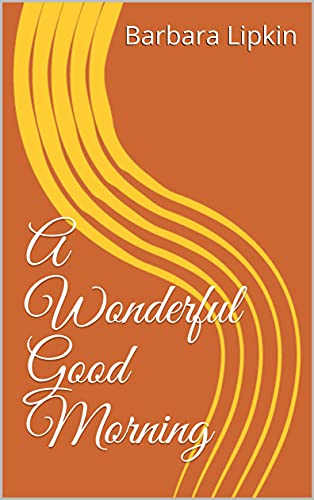
What do you think of when you hear the words “Science Fiction?” I tend to think of things like space ships, little green men, and robots. Yet my new novel, A Wonderful Good Morning, contains none of those things. So why is it classified as “Science Fiction?”
The problem is that every book needs to fit into a genre, a known category, in order to be marketable. But how do you classify a novel that doesn’t really fit into any of the standard genres? I wish I had the answer to that question.
A Wonderful Good Morning is about climate change. It’s also a mystery story involving travel and art and even a little romance. So why call it “Science Fiction?” Well, because in writing about climate change, I took what’s known about some aspects of our warming planet and created a story that’s grounded in reality but then takes off into a world of my own imagination. I suppose I could have called it “Fantasy,” but that word brings complications, also. It conjures up images of shape-shifting creatures and witches and demons, which doesn’t describe my book any better than the words “Science Fiction” do.
So if you think of a more apt genre with which to classify A Wonderful Good Morning, I’d love to hear your suggestion.
The title is available as a paperback and as an e-book on Amazon.com. Click here to purchase a copy.
I’m excited to announce that my new Science Fiction novel is now available on Amazon in both Kindle and print versions. Thanks to everyone who pre-ordered the Kindle version, which you should have received yesterday. I hope you enjoy it, and will take a minute to write a review on Amazon and/or Goodreads.
I have to say, I never saw myself as a Science Fiction writer before. But like creating mysteries, writing sci-fi is a matter of asking yourself “what if?” In A Wonderful Good Morning, the what if? is–what if our world is changing even more than we realize? What happens to an ordinary person then?
Sometimes every day seems just like the one before. Sometimes, it really is the day before.
Strange things have been happening to Tim for a while now. Lately, his friends have learned to treat him very gently until he comes out of one of his spells. His girlfriend, Natalie, decides a Rhine River cruise will be just what the two of them need to get things back to normal, but at the last minute, Tim is left to sail on his own. That’s when things get really weird. While he stares, yet again, at the very same clumps of algae in the very same stretch of the Rhine he’s been looking at for days, something finally clicks. Now the only problem is – how to fix it.
Meanwhile, Natalie and her artist friends back in Chicago wonder why Tim hasn’t returned from his vacation and why he doesn’t answer his phone. It’s not like him to just disappear; he’s normally super responsible. They have no choice but to set off for Europe to find out what’s going on.
I finished revising Riva’s Journey, the fictionalized memoir of my grandmother’s life from the time she came of age in the Jewish Pale of Settlement to the time she came to feel like a real American, after the second World War. So now, I’m on Round #2 of searching for an agent to help me get my manuscript published.
As I mentioned with regard to my Science Fiction novel, A Wonderful Good Morning, searching for an agent is probably one of the most tedious endeavors I’ve ever attempted, but therein lies the route to traditional publishing. I’ve given myself a deadline of June 30th. If I don’t have a positive response by then, I will self-publish with the help of Kindle Direct Publishing, as I have done with my Bella Sarver Mystery Series. But it would certainly be nice to have the backing of a traditional publisher, with its many resources for marketing and promotion.
So one way or the other, watch for my two newest novels, out later this year.
There’s a curse, erroneously attributed to an old Chinese proverb, that goes, “May you live in interesting times.” I find myself living now, in the last part of my life, in an interesting time, and wishing that things were a bit less interesting. Actually living history is nowhere near as much fun as reading about it. Times of political unrest and instability, pandemic, and economic collapse with their attendant tension and uncertainty is definitely not what I would have wished to experience in my old age. It occurs to me that my grandmother’s life was exactly the opposite of my own in that respect. Thankfully, her old age was peaceful and secure, but much of her life, well into late middle age, was conducted amid just such uncertainty. She lived in very interesting times.
I never quite realized how tumultuous my grandmother’s life was until I started writing her “memoir” a few months ago. Researching my book, Riva’s Journey, has been a fascinating journey of discovery for me. I always loved my grandmother but now I also admire the incredible courage and resilience that got her through her “interesting times” with all her love and humor and compassion intact. She would have said her life was unremarkable, no different from millions of other women who came from the same time and place. In a way, that’s true, but that’s also the point; that’s what makes her a hero in her own way. She just put one foot in front of the other, all the way through. Truly a Woman of Valor. Thanks, Grandma.
One thing good about being a painter and a writer is that I always work from home, anyway. So keeping busy has never been a problem. I’ve just sent A Wonderful Good Morning off to my Beta readers for comments and corrections, and then, one more final editing (I hope it will be final), and it will be ready for release.
Writing this book has been an interesting process, taking me a bit out of my comfort zone by venturing into the supernatural. Meteorologist Tim Pfeiffer and his girlfriend Natalie take off for a romantic river cruise on the Rhine, but Tim runs into a problem when the ship takes a detour into another dimension. The story is my take on what happens when we humans mess with Mother Nature.
On an entirely different tack, my next effort will be a fictionalized memoir told by my grandmother, who was born in what is now Ukraine in 1884 and died in Chicago in 1975. In between, she saw her world turned upside-down, not once but several times. I’m researching her life and times and finding it all fascinating. Can’t wait to see how it turns out! Working title: Riva’s Journey.